Nightly Recharge™ recovery measurement
Nightly Recharge™ is an overnight recovery measurement that shows you how well you recover from the demands of your day. Your Nightly Recharge status is based on two components: how you slept (sleep charge) and how well your autonomic nervous system (ANS) calmed down during the early hours of your sleep (ANS charge). Both components are formed by comparing your last night to your usual levels from the past 28 days.
Your Polar 360 automatically measures both sleep charge and ANS charge during the night. You can see your Nightly Recharge status in the Polar Flow app. Nightly Recharge helps you make optimal choices in your everyday life to maintain overall well-being and reach your training goals.
 How to start using Nightly Recharge?
- Tighten the wristband firmly around your wrist and wear the device when you sleep. The optical heart rate sensor on the underside of the device must be in constant touch with your skin. For more detailed wearing instructions, see Wearing Polar 360.
- You need to wear your device for three nights before you start to see the Nightly Recharge status in the Flow app. This is how long it takes to establish your usual level. Before you get your Nightly Recharge you can view your sleep and ANS measurement details (heart rate, heart rate variability and breathing rate). After three successful nightly measurements you can see your Nightly Recharge status in the Polar Flow app.
Nightly Recharge in the Flow app
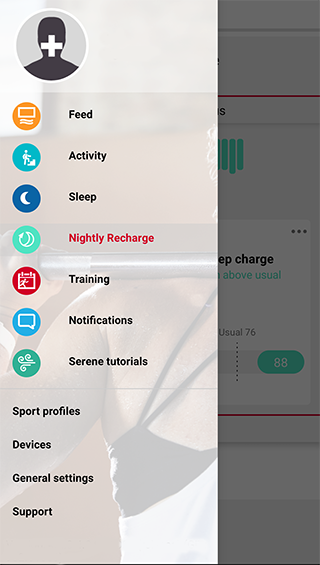
You can compare and analyze your Nightly Recharge details from different nights in the Polar Flow app. Choose Nightly Recharge from the Flow app menu to see the details of your last night's Nightly Recharge. Swipe the display right to see the Nightly Recharge details for previous days. Tap the ANS charge or sleep charge box to open detailed view of ANS charge or sleep charge.
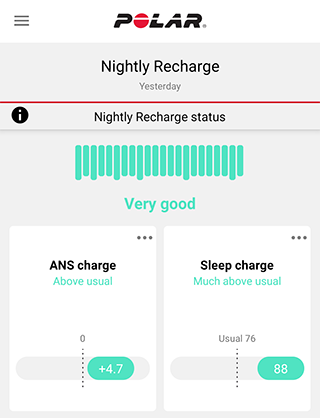
ANS charge details in the Flow app

ANS charge gives you information on how well your autonomic nervous system (ANS) calmed down during the night. The scale is from -10 to +10. Around zero is your usual level. The ANS charge is formed by measuring your heart rate, heart rate variability and breathing rate during roughly the first four hours of sleep.
A normal heart rate value for adults can range between 40 and 100 bpm. It is common for your heart rate values to vary between nights. Mental or physical stress, exercising late at night, illness, or alcohol can keep your heart rate up during the early hours of your sleep. It's best to compare your last night's value to your usual level.
Heart rate variability (HRV) refers to the variation between successive heart beats. In general, high heart rate variability is linked to general good health, high cardiovascular fitness and resilience to stress. It can vary greatly from person to person, ranging from 20 to 150. It's best to compare your last night's value to your usual level.
Breathing rate shows your average breathing rate during roughly the first four hours of sleep. It is calculated from your beat-to-beat interval data. Your beat-to-beat intervals shorten when you breathe in and lengthen when you breathe out. During sleep, breathing rate slows down and varies mainly along with sleep stages. Typical values for a healthy adult at rest range from 12 to 20 breaths per minute. Higher values than usual may indicate a fever or impending illness.
Sleep charge details in Polar Flow
For sleep charge information in the Polar Flow app, see Sleep data in the Flow app and web service.
Learn more about the Nightly Recharge in this in-depth guide.